
AI learning simulations
Build AI simulations around the skills you need to teach.
Create realistic role-play and guided case discussions, with feedback aligned to your learning goals.
Build with your team, work alongside ours, or have us deliver your first simulation.
Browser-based practice on desktop and mobile. No headset required.
See the platform and discuss your idea. No files required.
What you can shape
Your scenario. Your learning goals.
Define who the learner speaks with, the situation they face and the skills they need to practise.
Character and conversation
Shape what the character knows, how it responds and when it shares information.
Feedback and scoring
Define what to recognise, what to improve and how to score performance when needed.
Choose the presentation
Use a photorealistic character or a contextual 3D setting to suit the experience.
Platform experiences
Choose how your learners practise.
Practise a conversation with an AI character
Create a customer, patient, colleague or other role for learners to interact with. They ask questions, explain decisions and respond as the conversation develops.
- Customer and client conversations
- Healthcare and professional communication
- Leadership and difficult conversations
Work through a case with an AI tutor
Give learners a situation to think through and ask them to explain their approach. The tutor uses follow-up questions to explore their reasoning and support reflection.
- Case-based decision making
- Clinical or workplace reasoning
- Guided coaching and reflection
Practise. Get feedback. Try again.
Learners work through a realistic situation, respond in their own words and receive feedback on what they did well and what to improve. Use the experience for practice and reflection, with scoring added when your learning goals require it.
Start with a clear brief
Understand the situation, the role and what the conversation needs to achieve.Have the conversation
Ask questions, explain decisions and respond as the situation develops.Review the feedback
See strengths and gaps linked to the skills the activity is designed to teach.04
Practise again
Use the feedback to prepare for another attempt or a conversation with a coach or instructor.
A conversation, followed by feedback learners can use.
These screenshots show a customer-service simulation: a conversation with an AI character, followed by structured feedback. The topic is an example; the scenario, roles and feedback criteria can be adapted to the skills you need to teach.
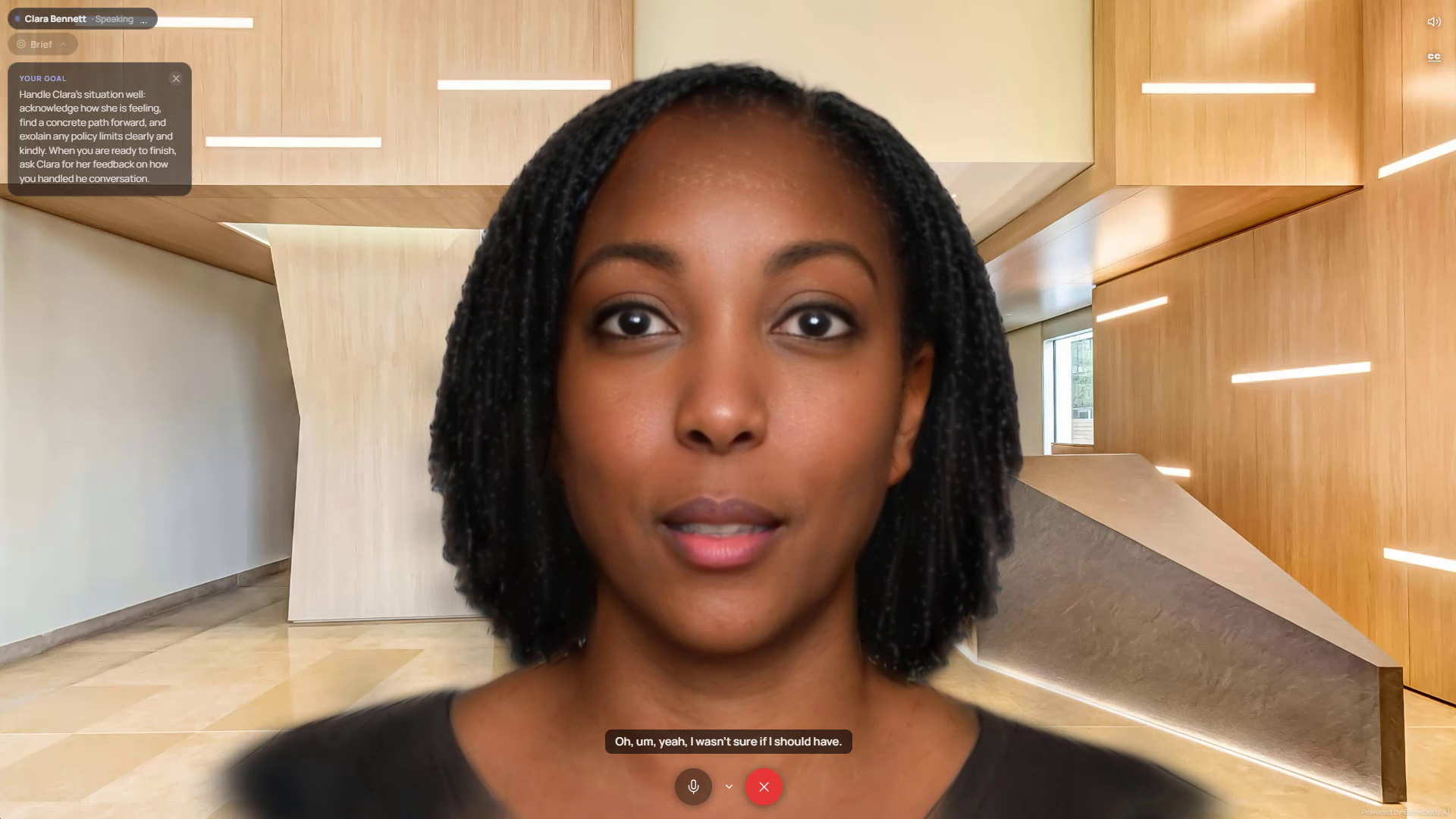
Speak with an AI character
A brief sets the situation. The learner asks questions and responds naturally, with voice controls and captions on screen.
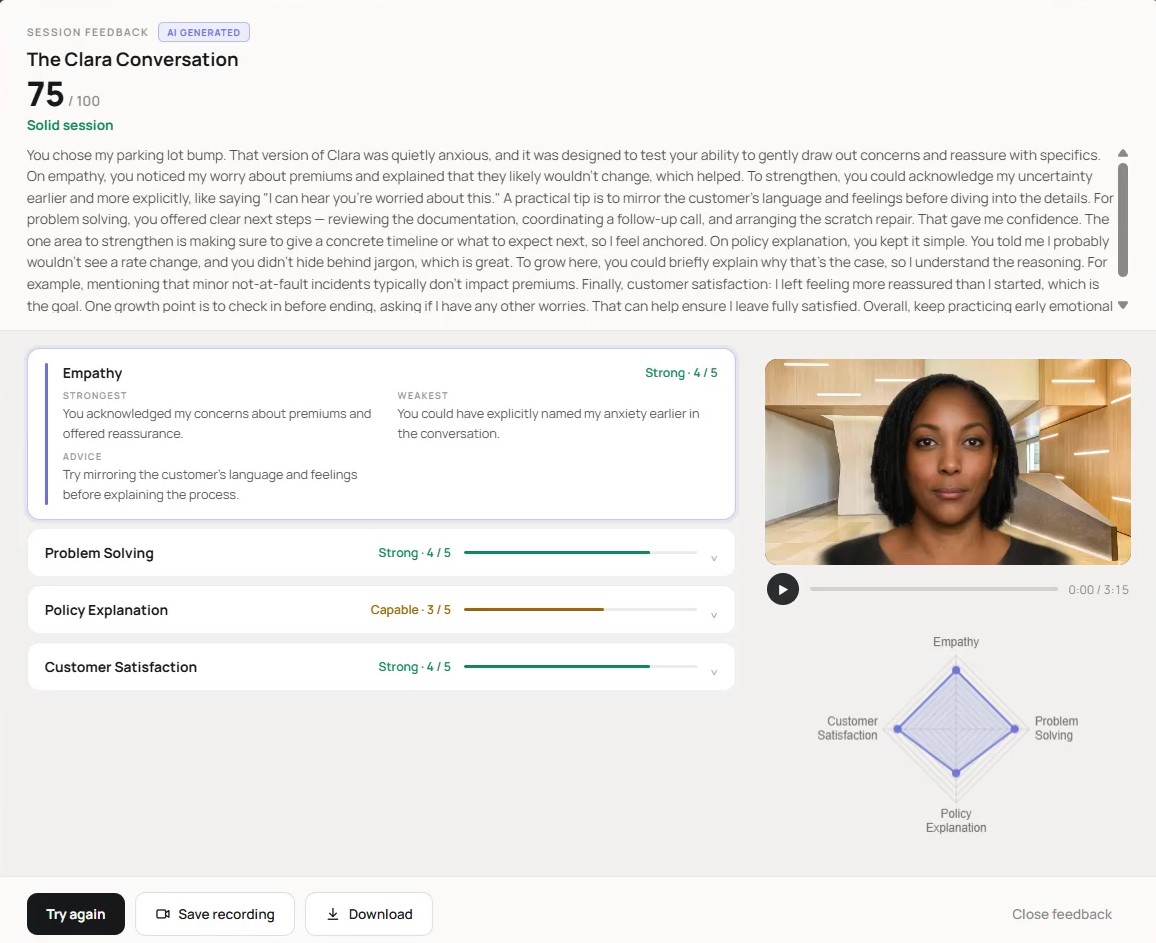
Review practical feedback
The report brings together an overall score, feedback by skill and practical advice for the next attempt.Feedback aligned to your goals
Make clear what a good response looks like.
Useful feedback starts with clear criteria. Define what learners need to say or do, what should be recognised and where a score is needed. We can help turn your rubric or performance standards into testable instructions and review the results with your subject experts.
This customer-service example illustrates one communication skill. The criteria should reflect your situation and learning goals.
Your learning criterion
“Responds empathetically to the customer’s concern.”
What to look for
The learner acknowledges the concern and invites the customer to explain it before moving to advice.
Feedback learners can act on
“You acknowledged the concern. Next time, ask what worries the customer most before offering advice.”
Illustrative example—not a complete rubric.
Design and implementation support
Bring us in for the parts you need.
The platform provides the learning environment. Our team can help with scenario design, prompt development, feedback criteria and testing. We agree the scope with you, including whether scoring and result delivery are needed.
01
Agree what good looks like
Start with your learning goals and scenario. Define the responses to recognise, the feedback to give and any scoring requirements.
02
Develop and test the prompts
Shape the character’s role, knowledge and responses. Test that it handles the scenario, stays within its boundaries and responds appropriately to difficult inputs.
03
Check the feedback and scores
Test weaker, borderline and stronger responses. Compare the feedback and any scores with expectations agreed by your subject experts, then refine the build.
04
Prepare it for rollout
Review the experience with your team. Where results need to reach an LMS or another system, confirm the supported delivery route and test it before release.
Verification support
Review the evidence before rollout.
Our verification work helps your team review the scenario, feedback and test results before rollout. Where scores are required, we compare them with agreed examples—not just a single overall total.
Feedback linked to your criteria
Check which part of the learner’s response supports the feedback or score, and where evidence is missing.
Role and safety checks
Review how the character handles leading questions, missing information and the boundaries of the scenario.A documented review
Record the agreed criteria, test results, remaining limitations and release decision.Check each skill, not just the total.
For a test conversation with an agreed result, compare each skill score with the AI’s score.| Skill | Agreed score | AI score |
|---|---|---|
| Information gathering | 4 / 6 | 4 / 6 |
| Judgement | 5 / 6 | 5 / 6 |
| Communication | 6 / 6 | 6 / 6 |
| Total | 15 / 18 | 15 / 18 |
Start with the support your team needs.
Review an existing simulation
Already have a prototype? We review the character’s behaviour, feedback, scoring and delivery requirements, then identify what needs attention.
Have us build your first simulation
Bring a scenario or learning goal. We handle the build and testing, with your team providing subject expertise and review.
Learn to build and maintain your own
Use the platform with your own team. If you want a guided start, we can co-build the first simulation and teach you how to create, test and update the next ones.
What would you like to build?
Tell us about a conversation or decision your learners need to practise. We will show you the platform and discuss the experience, the feedback and the support you need.