
TL;DR
- AI-supported oral defence can connect submitted work to questions that reveal how a student uses evidence and responds to a challenge
- Adaptive questions need shared intellectual demands, accessible participation and an educator’s view of the exchange
- The conversation adds evidence of understanding; its value depends on thoughtful review and integration with the wider assessment
A student submits a persuasive paper, complete with a confident recommendation and neatly presented sources. The educator still needs to know how the student would explain a questionable assumption or respond when an important condition changes. Scheduling an individual conversation for every submission can be difficult, yet a written comment may never uncover the uncertainty. AI oral assessment in higher education offers a way to connect the submission with a responsive discussion. The opportunity is to make reasoning visible through questions that follow the work, while giving educators evidence they can interpret and students a meaningful chance to explain.
Turn the submission into an intellectual exchange
Imagine a student recommending that a university replace its diesel shuttle buses with electric vehicles. The paper estimates emissions savings and argues for immediate replacement. A conventional response might comment on the calculation or ask for stronger references. An oral defence can investigate what the student understands about the choices behind the recommendation.
A useful opening question asks what the emissions estimate includes. The student explains that it compares fuel consumption with electricity use. A follow-up explores whether vehicle manufacture and charging infrastructure fall inside the comparison. The value is in discovering how the student defines the claim and what they recognise as outside its scope.
The discussion can then examine the evidence. Why is a national electricity-emissions factor suitable for this campus? The student might explain the choice, identify a limitation or recognise the need for a more local estimate. Each response creates a different, relevant direction for further questioning.
Finally, a changed condition tests the argument: what if the budget covers only part of the fleet? A thoughtful answer may propose a phased replacement, explain which routes should come first and acknowledge the information still needed. Revising a recommendation can demonstrate understanding when the revision is justified. Simply defending the original position more forcefully would reveal less.
This is an illustrative exchange, rather than a reported student result. Its strength is the relationship between the paper, the question and the learner’s developing explanation. The conversation gives the educator something the finished submission alone leaves uncertain.
Coordinate the questions around the developing argument
Our oral-defence development work with LearnBrite connects learner-created papers and slides with a spoken presentation and subsequent questioning. A designed experience can bring presentation capture, a conversation record and, where appropriate, the student’s camera into the same activity. Those materials create opportunities for review, but collecting them is only part of the design.
The more significant capability is a coordinated response to what the learner says. Distinct questioning roles can examine understanding, evidence and argument while drawing on the submitted work and the developing exchange. Shared context allows an explanation offered to one role to inform a later question from another.
In the shuttle example, an evidence-focused role might identify that the emissions estimate excludes infrastructure. An argument-focused role can then ask how that limitation affects the recommendation. The student should not need to repeat the entire explanation, and a later question should acknowledge a correction already made.
Coordination also requires restraint. Repeatedly questioning an issue the student has resolved can turn a productive defence into a confusing interrogation. A useful system recognises when the required reasoning has been demonstrated and moves to another relevant demand. Real-time responsiveness describes that evolving experience; it does not establish a particular speech architecture or the validity of an assessment result.
Personalise the question without changing the standard
Students can submit very different arguments within the same assignment. Identical questions may fail to reach the important choices in each paper. Unrestricted adaptivity creates another problem: one student might explain a familiar concept while another faces an elaborate methodological objection.
A shared question blueprint keeps the intellectual demands recognisable. The learner explains a central concept, justifies an evidence choice, responds to a relevant challenge and accounts for any revision. The wording follows the submission, while the course determines what a sufficient response would involve. These dimensions can be adapted to the discipline without turning them into universal rubric weights.
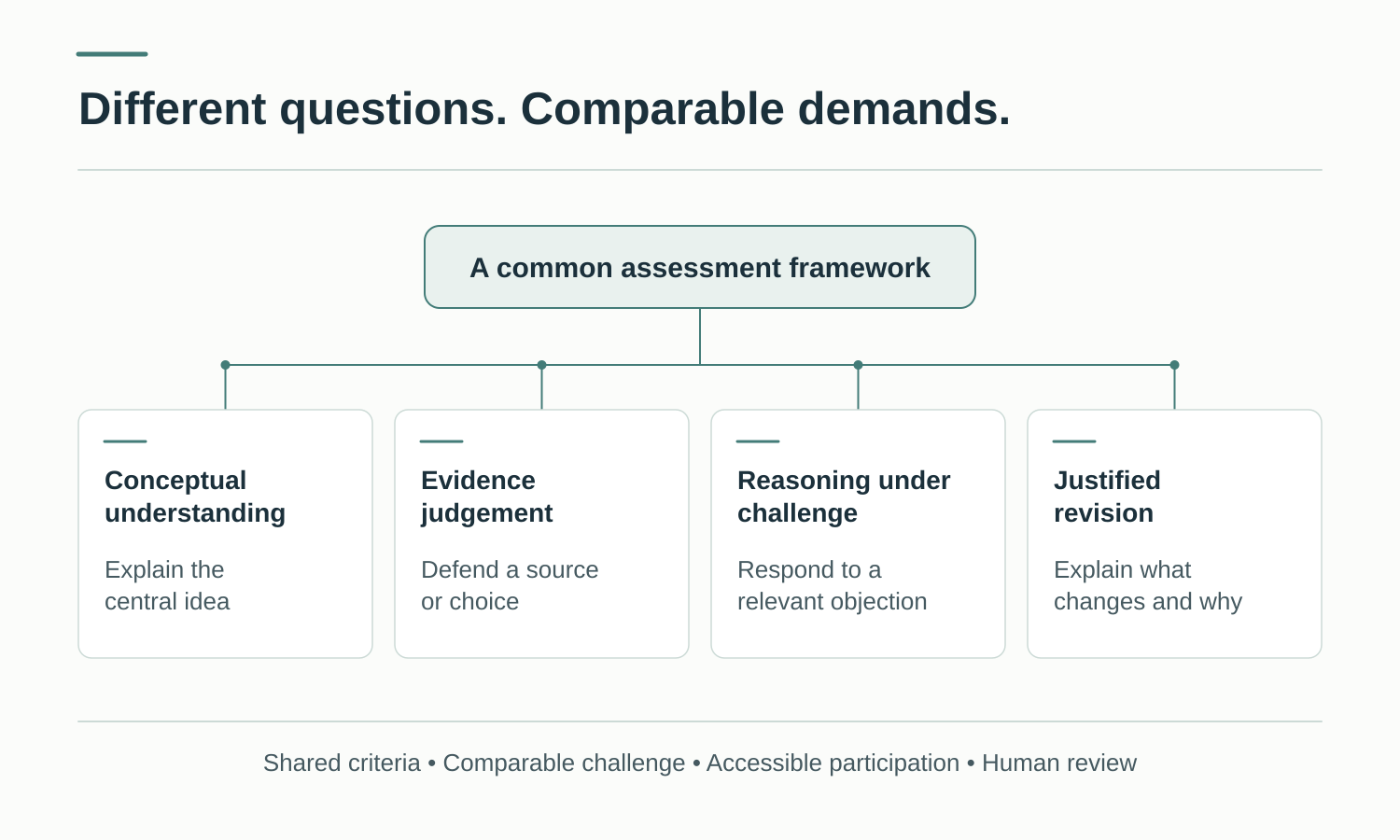
For a design rationale, the evidence choice might concern user research. For a history essay, it might concern the interpretation of a primary source. Both can require the student to explain why the evidence supports the claim, although the appropriate disciplinary judgement will differ.
Follow-up questions need similar boundaries. Asking a student to clarify a term can preserve the opportunity to answer. Supplying the missing explanation and asking them to agree changes the demand. A useful defence leaves room for clarification without giving some learners extensive coaching that others never receive.
Comparability therefore involves the opportunity to demonstrate the outcome, the relevance of the challenge and the assistance available. Equal numbers of questions or identical durations do not settle those matters. Educators need to examine how different conversational paths affect the task students actually encounter.
Design access around what the course intends to assess
An oral defence makes speaking visible, even when speaking is not the learning outcome. A student may understand the subject while needing longer to organise a response, using assistive communication or finding an unfamiliar presentation setting difficult. Confidence, accent and rapid delivery should not become hidden measures of disciplinary understanding.
The distinction begins in the assignment brief. If the course assesses professional spoken communication, students need to know which aspects matter and have opportunities to practise them. If it assesses reasoning about a submitted argument, presentation polish should not quietly determine the result.
Practice questions and a familiarisation experience can help students understand the format before the assessed encounter. Appropriate adjustments may involve thinking time, breaks, advance questions or an alternative way to respond, depending on the learning outcome. Oral-assessment accessibility guidance illustrates those choices. Institutions should develop arrangements with their accessibility teams and the individual learner, rather than assume one adjustment fits everyone.
The interaction itself needs examination. A system that repeatedly interrupts thinking time may prevent a student from completing an otherwise sound explanation. A microphone problem or misrecognised specialist term can change the record before an educator sees it. We recommend checking those conditions with the intended learners and providing a way to clarify or correct the record. Students should be able to concentrate on the intellectual task without having to diagnose the technology while answering.
Give educators a usable record of the defence
A conversation can produce a substantial record. Its usefulness depends on how readily an educator can find the important moments and understand their context. The review should connect the submitted claim, the question asked and the learner’s response, including any change of position.
In the shuttle example, a summary saying “The student understood the limitations” leaves too much unresolved. Which limitation did they identify? Did they recognise it independently, or did the question supply it? How did it affect the recommendation? A navigable record lets the educator answer those questions without treating an AI summary as the whole account.
Audio or presentation capture may help where a transcript is ambiguous. It also creates responsibilities around access, retention and the purpose of collection. Students need to understand what is recorded, who can review it and how they can report an error. Recording a camera feed should have an explicit educational or institutional purpose.
Consequential judgements need a clear human review and challenge route. A misunderstood technical term, missing phrase or question outside the assignment’s scope can change the apparent performance. The institution needs a way to resolve that uncertainty while preserving a fair opportunity for the student to demonstrate the intended learning.
Keep integrity claims proportionate to the evidence
Oral defence can contribute to assurance of learning by asking a student to use ideas in a connected exchange. It cannot establish who wrote a paper from fluency or hesitation. A confident response does not prove independent authorship, and difficulty answering does not prove misconduct.
The conditions matter. Students should know what assistance is permitted in preparing the submission and during the conversation. Where independent performance is required, the institution needs arrangements appropriate to that requirement. Adding an AI questioner or a recording alone does not make an assessment secure.
The broader purpose is consistent with TEQSA’s assessment-reform guidance, which connects assurance of learning with responsible AI use and advocates multiple, inclusive and contextualised approaches. An oral defence can add a valuable perspective within that design. Other tasks remain necessary where the course needs practical performance, wider knowledge coverage or evidence developed over time.
Judge wider use by what the experience adds
A compelling demonstration makes the possibilities tangible. A defensible decision about wider use needs to examine whether the questions remain relevant, students can participate and educators can interpret the resulting evidence. Review workload belongs in that picture. More recordings are helpful only when the institution can use them meaningfully.
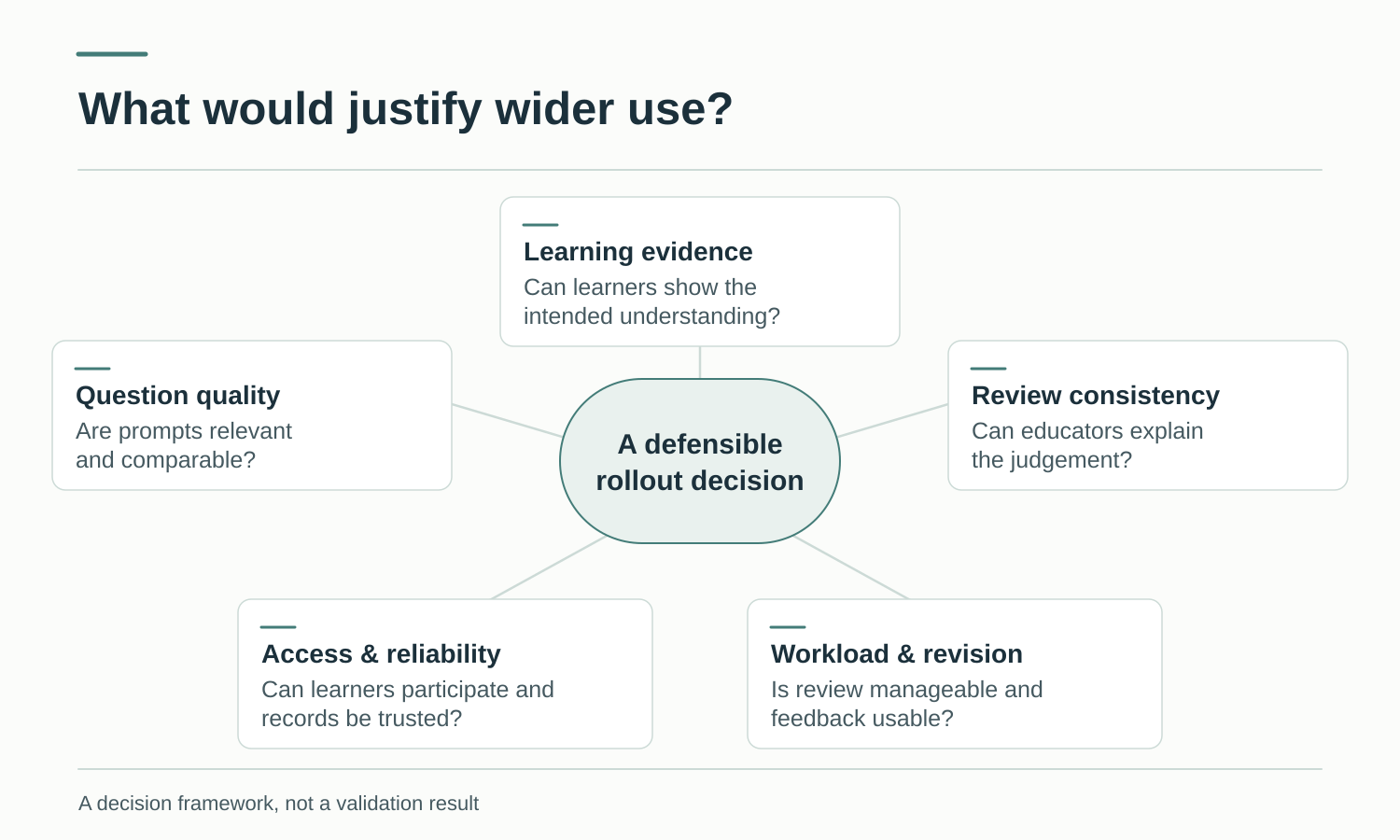
The framework brings together learning evidence, question quality, review consistency, access and reliability, and workload and revision. It identifies considerations for a decision rather than prescribing a cohort size or presenting measured results.
A productive formative use can connect the defence back to the assignment. After discussing the shuttle proposal, the learner might revise the boundaries of the emissions comparison and explain why that changes the recommendation. The educator can examine whether the revision addresses the issue exposed in the exchange. That is useful learning evidence; attributing improvement to the AI experience requires an appropriate evaluation design.
The strongest starting point is an assignment where explaining choices already matters: a research proposal, capstone, design rationale or policy recommendation. Explore LearnBrite’s AI learning simulations platform with the reasoning you want students to demonstrate. We can discuss how submitted work, coordinated questioning, feedback and educator review could come together around that learning goal.
Recent Comments