
TL;DR
- An explainable score connects an assessment criterion to eligible learner evidence, including the help provided during the conversation
- Calibration needs to examine individual criteria, difficult boundary cases and the difference between repeatable scoring and educationally sound judgement
- Useful feedback and reviewable records turn the result into something learners and educators can question, understand and use
A learner challenges the result of an AI conversation assessment. They remember explaining their reasoning; the feedback says they did not. The educator opens the transcript and finds relevant words, but also a leading question and a tutor recap. Which contribution actually earned the score? This is where assessment quality becomes concrete. Educators need a defensible account of what the learner demonstrated, under what conditions and against which expectation. A well-designed conversational assessment can provide that account, making a difficult judgement easier to inspect and the next learning step easier to identify.
Decide what the result should mean
Conversation can reveal several kinds of achievement. A learner might recognise a concept, apply it to a case, explain a relationship or respond to a competing interpretation. Those demands need distinct treatment. Otherwise, a fluent response can receive credit for reasoning it never makes explicit, while a brief, sufficient explanation is overlooked.
The intended use matters too. Feedback during practice may help a learner choose what to revisit. A result contributing to a consequential grade must support a stronger decision about achievement. The Standards for Educational and Psychological Testing place the intended interpretation and use of scores at the centre of the validity argument. Consistent output is useful evidence, but it cannot establish that the right skill was assessed.
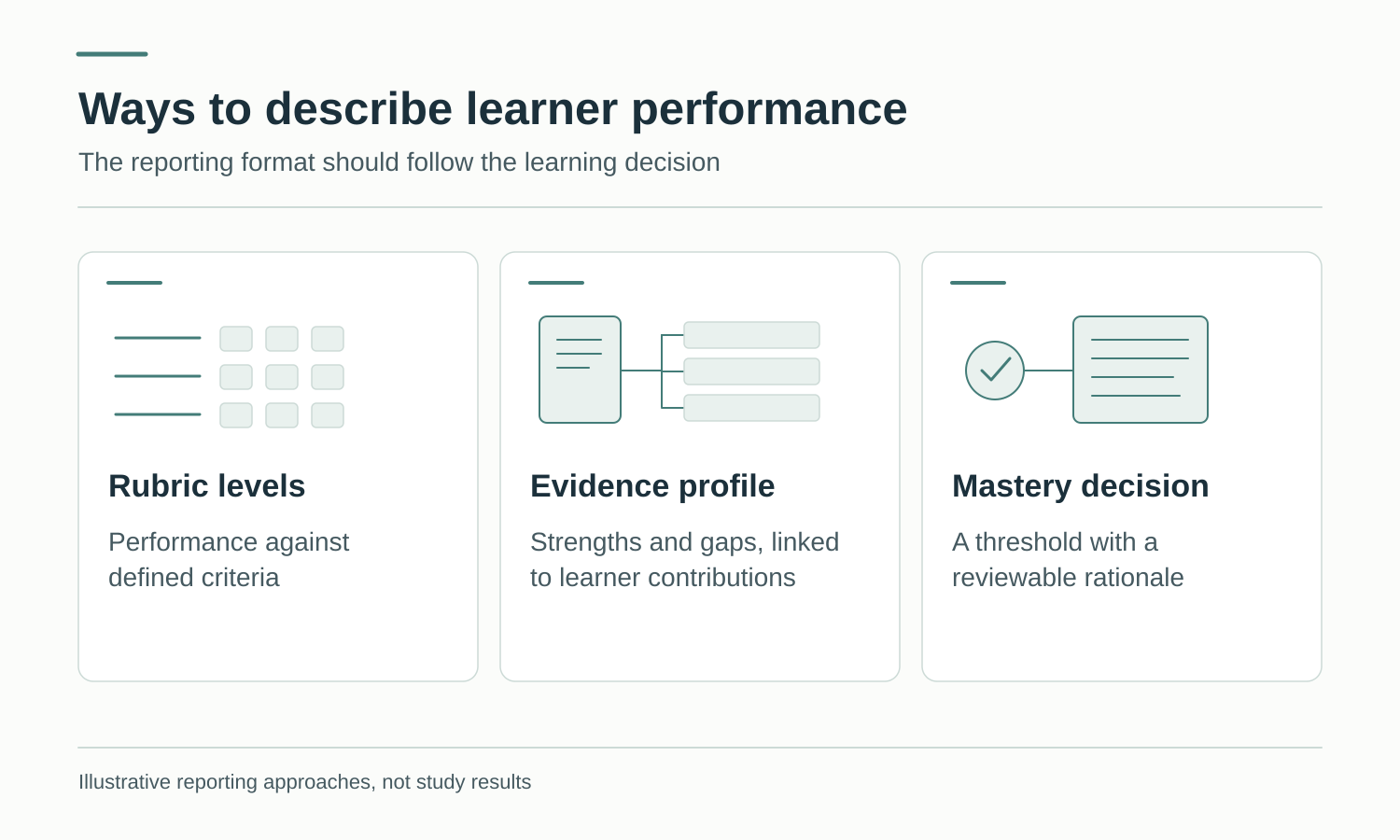
Reporting follows that educational decision. Some courses need a profile of strengths and gaps; others need a mastery judgement or descriptive feedback. An overall total can be helpful when its meaning is clear. It can also hide the distinction an educator most needs to see. The reporting formats below illustrate different choices, rather than measured results.
Make the criterion visible in the learner’s explanation
In medical-school learning design, an important task is distinguishing an action from an intermediate change and a longer-term outcome. Learners may understand the labels while struggling to explain how the elements connect. Rubric-based AI assessment becomes useful when it can preserve that distinction.
Consider an illustrative case about a student designing a community learning programme. The proposal offers workshops, aims to improve participants’ ability to interpret information and ultimately seeks better-informed decisions. Asked to explain the relationship, one learner says, “Workshops create better outcomes because people learn more.” The answer contains the expected categories, but the causal connection remains largely asserted.
Another learner explains that participants would practise comparing conflicting information, become better able to identify unsupported claims and then use that skill when considering a decision. They add that workshop attendance alone would not demonstrate the intermediate skill. This response offers a mechanism and recognises a limit on the evidence.
A useful rubric can recognise accurate classification in the first answer while distinguishing the stronger explanation in the second. It should not require the learner to repeat one approved sentence. Several defensible mechanisms might satisfy the criterion, and subject experts need to define the relevant boundaries.
This is the educational judgement beneath the score: what makes an explanation sufficient? If faculty disagree because “clear reasoning” means different things to different people, the descriptor needs work. Giving the same vague phrase to an AI evaluator simply moves that ambiguity into an automated process.
Keep assistance separate from independent evidence
The conversation itself can change what a response demonstrates. Suppose the tutor asks, “Would comparing conflicting information help participants recognise unsupported claims?” The learner agrees and later repeats the connection. The resulting statement is relevant, but its origin matters. The tutor supplied the mechanism that the task was intended to elicit.
That does not make the exchange educationally worthless. Recognising a useful explanation can be part of learning, and supported performance may be exactly what a formative activity seeks. The assessment record should describe it accordingly. Independent generation, recognition after a hint and revision following feedback support different interpretations.
Self-correction needs the same care. A learner who notices a contradiction and repairs it without assistance has produced evidence of monitoring their reasoning. A learner who revises after an explicit explanation has demonstrated something else. The sequence helps an educator understand the achievement without treating every final answer as if it appeared unaided.
Coordinated conversational systems can support these distinctions by keeping the questioning, assistance and assessment responsibilities aligned. A recap can remain limited to learner-generated ideas while further teaching waits until the scored exchange is complete. What matters is whether the experience follows the agreed assessment conditions, including when a learner asks for help or takes an unexpected but reasonable route.
An explanation needs evidence a reviewer can inspect
An explainable result should bring the reviewer to the learner’s relevant contribution and the criterion it supports. It also needs enough surrounding context to show what was asked and what assistance preceded the answer. Quoting a sentence alone can conceal that the system had already supplied most of it.
In the workshop example, a reviewable judgement might recognise that the learner identified an intermediate skill but had not explained how it would influence the later decision. The educator can inspect that interpretation against the exchange. If the learner did explain the connection elsewhere, the result can be challenged on specific evidence.
A plausible explanation generated after scoring is insufficient if it cannot be reconciled with the record. The same applies when a summary smooths over a contradiction or attributes a tutor contribution to the learner. Concise reporting should reduce the effort of finding evidence while preserving the distinctions that affect the judgement.
Missing input belongs in that account. An unfinished session, interrupted answer or lost phrase creates uncertainty about what was demonstrated. An incomplete record should remain identifiable and have an appropriate review route. Treating a microphone failure as an observed misconception gives a technical event an educational meaning it does not support.
Calibration should expose difficult distinctions
Calibration asks whether the evaluator separates performances in the way subject experts intend. The revealing examples are often close to a boundary: fluent language with weak reasoning, a concise explanation that satisfies the requirement, or accurate categories combined with an unsupported connection.
Our documented medical-school development work illustrates why those contrasts matter. Contrasting learner profiles exposed a weakness in how vague reasoning received credit. Correcting and retesting that behaviour established how a particular version handled those examples. Such a record is useful because it identifies the judgement that changed; it does not establish grading accuracy across a learner population.
Educator disagreement also deserves attention. Where reviewers interpret the same answer differently, the cause may be an unclear descriptor, a genuinely borderline performance or missing context. Treating one unexplained human score as the unquestionable answer can conceal the same problem the calibration was supposed to resolve.
Repeatability and alignment with expert judgement are separate questions. A 2024 study of AI essay scoring found greater self-consistency for GPT-4 than GPT-3.5 in repeated scoring of a small subsample; its main GPT-3.5 comparisons showed fair-to-moderate agreement with human scores. Those findings concern written essays and particular model versions. They support checking both properties locally, rather than estimating the accuracy of a current conversational assessment from another task.
Criterion-level review matters because offsetting errors can leave the total unchanged. An evaluator might over-credit explanation and under-credit application, producing a plausible overall result with a misleading account of the learner. Live conversation adds another question: did the learner receive a fair opportunity to produce the evidence? Stable scoring of a fixed transcript cannot answer that by itself.
Feedback should make the next attempt more purposeful
Scoring describes performance against the standard. Feedback helps the learner decide what to do next. “Improve your reasoning” offers little direction. In the workshop case, useful feedback could identify the missing connection between recognising unsupported claims and making a decision, then invite the learner to explain that step using a concrete example.
The timing matters. An explanation supplied during the assessed exchange may change the evidence; the same explanation afterward can support revision. Feedback should acknowledge what the learner did achieve, identify the consequential gap and avoid burying it beneath generic advice.
Research gives a reason to examine feedback separately from scores. A 2024 comparison of human and ChatGPT feedback on secondary-school writing found human feedback stronger on accuracy, actionable direction, prioritisation and supportive tone, while AI feedback referred more explicitly to criteria. Rubric language alone therefore does not establish usefulness. The study assessed feedback quality, rather than learning gains from conversational tutoring.
LearnBrite’s public AI simulation feedback example illustrates how an overall result, skill-level feedback and practical advice can appear together. The educational value depends on what those elements communicate and the evidence an educator can inspect behind them.
Preserve the meaning when the experience changes
A paced exchange, real-time voice conversation and 3D presentation can each support assessment. They can also change the evidence available through turn-taking, capture, interruptions and the timing of assistance. Testing one implementation does not automatically establish equivalent judgements in another.
Updates to the rubric, scenario or underlying model can similarly change which responses receive credit. Maintaining a record of the tested configuration and revisiting meaningful examples helps educators understand what remains supported. Accurate reporting on screen and accurate transfer into a learning system also require separate verification.
The useful outcome for an institution is an assessment it can explain and improve: a clear purpose, interpretable learner evidence, a checked judgement and a review route when something is uncertain. If you have a conversational prototype, explore LearnBrite’s AI learning simulations platform and review support. Bring an assessment decision you need to defend, and we can discuss the conversation, feedback and design support needed to make its evidence inspectable.
Recent Comments